 Apple Podcasts
 Spotify
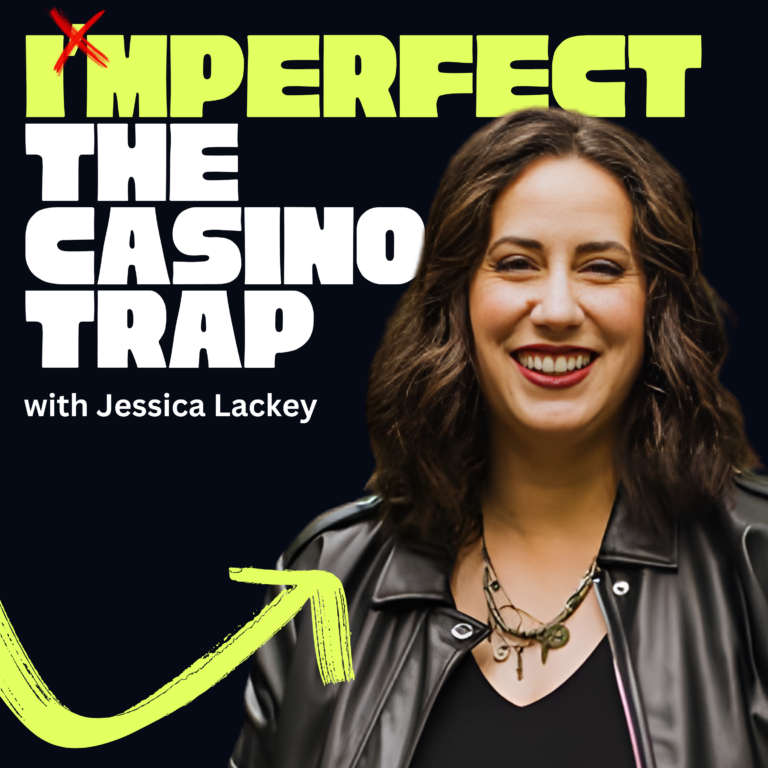
The online business world sells you a dream that doesn’t work. Jessica Lackey shares the reality outside of the entrepreneurial casino. We chat about the the real path – the long, hard path – that’s often the only way to sustainable success.
Check out the full episode highlights over on Substack.
Full Transcript
Mike: Jessica, welcome to the show.
Jessica: Thank you. Super excited to be here.
Mike: I want to launch straight in with the idea of the entrepreneurial casino, because I just finished reading your book and the way you describe it is so relevant to where I am right now — seeing this multi-billion dollar industry that’s selling the dream of entrepreneurialism, doing business online, how easy it all is, follow my course and so on. What was the moment where you were like, oh no, I’m in a casino?
Jessica: I was in the entrepreneurial casino for a while before I realised what it was. A little backstory: I hit a wall in corporate in 2015 and said, I don’t want to do this anymore. So I went on a long, circuitous route to figuring out what I wanted to do. I thought I wanted to become a holistic nutritionist, then a life coach. I got the certifications while still working in corporate. Then when I got my coaching certification, I moved to Charlotte, North Carolina, where I live now, and I started thinking, I want to be a coach.
This was 2018 — right around the time everyone was saying you can sell a course to your email list. So I bought one of those programs. And then I’m like, wait, I don’t have an email list. I’m side-hustling as a coach.
I took a couple of business-building programs. The first one was actually great. The second was a regurgitation of the first. Then in 2021 I left corporate — I couldn’t side-hustle my way to what I wanted because of how intense my job was. So I went all in and took another business-building program that was more of the same. I kept thinking, I’m not learning anything new here. But there was always another course, another program, and I come from a business background, I like to learn, so I kept going.
Then I get into this program where I’d had some modest success — not from what they were teaching me about growing social media and email lists, but through old-school networking, contract consulting, kind of the way McKinsey does it, which is my background too. And I get into this program run by someone billing herself as an ethical feminist business owner. She’s making multiple six figures from the program and everyone else is not making money. And that was around the end of the “boss babe” era, where the message was: you should all be millionaires, make these moves, hire these people — if you don’t have a VA, you are the VA. I’m looking at the numbers and thinking, this doesn’t work.
After I’d dropped serious money on a bunch of things, I woke up and I was like — they’re selling the dream. It’s repackaged content that worked five years ago and doesn’t anymore. That’s when I realised I’d been taken for a ride.
Mike: It’s like an MLM, all the way down. Coaches teaching coaches how to coach, how to get a following — basically get rich by buying my course, how to get rich, all the way down the pyramid.
Jessica: It’s funny, because now I recognise that my business is teaching business skills, which means there’s some ethical guilt around it — like, my business is teaching people how to do business. I’m not part of the casino, but I am selling business education as opposed to just doing the service, which makes me casino-adjacent. I like to think I’m teaching good things. It’s grounded in all the stuff no one’s telling you. But I also recognise that I’m selling you a shovel rather than being out there searching for gold myself. I’ve done both. But I recognise that now I’m part of the educational complex, even if I’m out of the casino.
Mike: I think the difference — and I just read your book — is that spotting the casino is spotting the fact that the main thing being sold is the dream. If you buy this course for $5,000, you’ll finally unlock some special thing that will help you make this much money. Whereas reading your book, I was almost shell-shocked but also relieved at the same time. The relief was, oh, I don’t have to do that. But then I’m reading and thinking, oh, but this is a lot of work.
Jessica: Yes. If I convince some people that, you know, maybe their job isn’t so bad — I never want anyone to stay in a toxic environment, but I do want people to recognise that you can build a business, and it requires much more commitment and dedication than what you’re being sold. Is it possible? A hundred percent. Does it require doing uncomfortable things that are going to stretch you for significantly longer than you think, and being willing to figure out how to get paid while you’re doing that uncomfortable work? Yes. It’s not a particularly sexy message. It doesn’t go viral at all. Which is why I’m glad the right people who are finding it are spreading the word — because this is not “10 steps to your millions.” This is the five-year arc of building something sustainable that still pays me less than my old corporate salary.
Mike: It’s like figuring out the long path — the eventual path to getting where you want to be, rather than the quick 10-day turnaround, or even a one-year turnaround.
Jessica: Pretty much.
Mike: Reading the book as well — and it’s funny because I’m someone who has a day job, and I did the same thing as you. I enjoy coaching, it’s part of my day job, so I went and got a coaching qualification, did a bit of coaching on the side. Then I thought, I’ve tapped out in terms of people in my network. Maybe I want to grow this more. And the logical conclusion always feels like, well, I should start posting on social media every day. Even reading your book, it still feels like — well, what am I supposed to do otherwise? It’s still so tempting to think, obviously I should be posting everywhere all the time. What else would I do?
Jessica: So in the pre-2020 era, social media was a discovery tool. It was designed around the social graph — you actually did see things from people your friends followed, it served you adjacencies. LinkedIn still does that somewhat. So it actually did work. And it was less saturated. Fewer people were creating content, it wasn’t so professionalised. Social media was an incredible way to find like-minded people and expand your network.
Social media stopped being social primarily when TikTok entered the scene. Now social media is passive content consumption, and unless used very intentionally, it’s a poor networking tool. So we have to go back to how we used to meet people — joining communities, joining programmes. It’s what realtors call belly-to-belly marketing. You’ve got to go door to door.
Which is actually why it’s harder. You might have to, as I say with love, put on real pants and leave the house. But you don’t have to do that either — I don’t do a lot of local networking anymore, but I’m in about 15 different communities at any given time. People ask how I keep track. I spend very little time on social media. When I’m on Substack, I’m not just posting things — I’m responding to comments, sharing things, signalling. But I’m intentionally putting myself in positions where I can expand my network.
Do you remember how you heard about the book, out of curiosity?
Mike: Like many people recently, I’m pretty sure it was Paul Millerd posting about it somewhere — either in his WhatsApp group or on Substack.
Jessica: Paul is the perfect example. Five years ago when I started, I was on Twitter looking for people who had left corporate to do something different. I started following Paul, then following some of his friends, then I bought his book, responded to one of his posts. It turned out he was going to the World Domination Summit in Portland, Oregon, and I was going too. So I made a point to — it sounds stalky but it wasn’t — track him down and have a conversation. I started sharing his book with people, and he actually connected me with a consulting firm for my very first project that got me paid. I don’t know if he knows that, but he made an introduction and that person gave me my first consulting project.
Five years later, you heard about my book from Paul through social media. We stayed in touch through social, but those relationships didn’t start there. Social media is a fantastic way to find your people if you’re intentionally searching — but it’s harder now than it was in 2020, 2021. What I do is what I call puppy dog internet theory: you find people you like and you literally follow them around the internet like a puppy dog. These are the communities they’re joining, these are the people they know, these are the places they spend time. You go support those people. You start creating your own six degrees of Kevin Bacon map by being like, these are people who’ve gone ahead of me — where do they spend time, who do they socialise with, let’s go make friends there and expand the ecosystem.
It all happened online, but it happened by using social media as a networking tool, not as a content-creation and posting tool.
Mike: So you use the network to find people who are interesting, then intentionally find ways to connect with them — hopefully in a nice way, not a creepy way — and see where that goes, without any expectation that five years later that person’s going to promote your book.
Jessica: Yeah, pretty much. It’s the long game of compounding. Someone is interested in one of my programmes right now because someone introduced them to my work, and that person was introduced to my work by someone else who joined my programme a year ago, and that person joined a year after she first heard about me because someone else had told her. It takes multiple years for your reputation to spread. Your job is to figure out how to make money and stay consistent long enough to stay in the game until the flywheel starts working on your behalf.
For me, it took a year to figure out how to make money at all. It took three years until I was making money from my own book of business consistently, and five years before I could say, okay, there’s momentum here. Now people are finding me without me having to do so much heavy lifting, because my body of work is substantial enough to carry that.
I got lucky that it only took five years. I published a book within my first five years — that was not a cheap endeavour. I’ve been writing a blog, doing a podcast, I have a YouTube channel. But I got lucky because I found something that gripped my soul and I ran it down. And I managed to turn my business from exclusively high-ticket, high-touch fractional COO work to a half-and-half mix of advisory consulting and leveraged offers. Five years is short for that. No one talks about that either. Five years to have authority assets that start to travel beyond you — five years is short.
Mike: There’s an interesting comparison I came across recently, comparing building a business to having a wine company. If you want to produce really good wine, you can’t just start selling the wine you’re going to sell in 10 years. As a company, you probably need an offer you can give in the short term — a wine you can sell six months in rather than four years in. You’re not going to put all your passion into that six-month thing. Your true passion might be the wine you want to start selling after five or 10 years. It sat in my mind because if you’re in my position — you don’t have a core offer that’s well established, you haven’t done this work for five years — it feels like you still need something now, while also investing in the future and thinking about what’s coming in five years. It’s a tricky balance.
Jessica: You’re building two businesses at once. You’re building the short-term business, which is probably just solving problems for people — whatever problems you can get your hands on that are relevant to your skills. For the first three years, I was doing high-touch fractional COO work. I was doing the job — pulling Salesforce reports, putting together monthly decks, doing cashflow forecasting. Sure, I couldn’t delegate it, but I honed my skills. I was also doing contract consulting based on my previous world — I was previously in supply chain planning at Nike and an appliance company, so I did contract consulting for sales and operations planning for food and beverage and apparel companies.
Tap your network. But I was doing job-job work for three years while I built my list. I actually tracked this down because I needed to show how long it takes and how hard the work is. I started my list in March 2022 with about 120 people. It’s now 2,000 — still not huge. And I didn’t play the social media game particularly well. Some people blow up quickly because they played the Twitter threads game when it was popular, or the Substack Notes game before the platforms got saturated. But because I was doing delivery-based work, I didn’t have the capacity to really do both at once.
I didn’t actively start selling to my email list until roughly a year or two years after I started it. I was making all my money through networking, referrals, and high-touch services, while sharpening my point of view. It’s only in the last two years that the leveraged side has really started to take off.
Mike: How did you resist the urge to try to monetise it earlier?
Jessica: I needed to get paid. I’m a practical person. I’m getting paid through services, and I didn’t have anything to offer the people who were on my list yet. So I just wrote what I thought, developed my point of view. I didn’t have time to monetise the other side, and I didn’t necessarily need to — when you’ve got two or three fractional COO clients each paying you $15,000 a month but you’re working 30 hours a week on keyboards for them, you take your 10 hours a week and you sharpen your point of view. I didn’t have time to sell anyone anything.
It was only when I started to build some kind of audience that I began winding down the COO work. One client sunset, then another, then another over the next two years. I ratcheted it down as my audience grew. Under the surface I was paddling like crazy — working 40 to 50 hours a week, 30 hours on core business delivery, 10 to 20 hours building an audience and writing the book. Only now can I take my foot off the gas a little. But it took five years of basically running two businesses at once.
Mike: That’s where the temptation comes from to step back into the casino, right? Because it always feels like an “and” — social media tells you, you need to hustle and work extra hard and do the work, but you should also be posting about doing that every day. It’s not pick one, it’s do both. And that’s where it becomes a slippery slope: well, then I need VAs to help me post more, I need a podcast, I need someone to help me edit it. It quickly becomes a situation where you’re pouring money into tooling and assistance and trying to grow, but you’re not actually going anywhere.
Jessica: I did the maths for a guest article I wrote. I didn’t make any actual profit from my leveraged business until last year. I made revenue — $5,000 to $10,000 my first year, $20,000 the second, $60,000 the third — but I spent it all. I spent money on an assistant I didn’t need, a social media team that didn’t get me any results, a podcast pitching agency that got me lots of podcast interviews but not many clients. I was thankful I could subsidise it with my services business, but I didn’t actually profit.
It costs a lot of money to run a content engine. You either pay with time or you pay with money. I didn’t have time, so I spent money. And thankfully I had money to spend because the reason I didn’t have time was that I was running a services business. Trying to run both at once is hard and expensive.
Now I’ve stepped back from a lot of that. Does my YouTube have to be perfect? No. I fired my assistant because, honestly, it’s cheaper for me just to do the scheduling myself than to pay someone else to do it. The effort has to go somewhere — the question is just where. And I think most people rely too heavily on the casino. They spend time learning — and I love learning, but I don’t love procrastination-learning, where you take another course instead of doing the work. Most people give up too early and focus on checking boxes rather than developing a genuine point of view.
And payment currency looks different at different stages. In the beginning, get paid in practice, get paid in portfolio, get paid in network. I hate the idea of working for exposure, but if you don’t have a case study, if you don’t have proof, if you don’t know what you’re doing yet — even if you’re an expert — do it for free, do it for cheap, just start doing it. Most people want results too quickly and aren’t willing to stick at it long enough to close the taste gap and actually get good.
Mike: That’s something I’ve been struggling to remind myself of. This is an entirely new thing that I’m new at. It would be really bizarre to expect results within even a year. Having skills as an individual contributor in a big company is completely different from doing all the marketing yourself, starting a business, handling finances, figuring out what to charge, figuring out how to get clients. It would be insane to think all you need to do is throw money at an expensive guru course and it’ll be done in six months. But you see it everywhere, people saying you can get results fast, and it’s just so tempting to think, yeah, sure, why not?
Jessica: And you don’t need to go to business school either. Let me tell you what they do not teach you in business school — they do not teach you how to set up your own accounting software. They teach you how to review an established company’s P&L, but they don’t tell you how to set up your chart of accounts, how to log an invoice so it’s not double-counting, what to do with credit card rewards because it shows up weirdly on your balance sheet. They teach you marketing for CPG companies, not how to write.
And people are going to read my book and think, wow, this is great — but my writing from 2018 is terrible. There’s a post that still gets some traction and I’m like, please don’t read this. It took me three years of writing to really find my voice. I looked at my Instagram posts from when I first started and they have no point of view, they’re boring. But they shouldn’t have had one — I was still developing. It took time to mature into my voice, to figure out CRM systems. Everyone says, go to business school to learn how to do business. But they don’t teach you how to do business in business school. I learned how to do business at Nike and McKinsey, in big companies. I only learned how to run a small business by figuring it out for myself.
Mike: There are skills you genuinely can’t learn from reading about them. Like outreach and networking. When I started the podcast, it was my excuse to reach out to people I was basically too scared to cold email. It was much easier to say, come on my podcast, than to just say, hi, can we be friends? But by doing that I started building resilience around asking people for things and asking to talk to people. And it has led to me now messaging people just to connect, no excuse, just saying — hey, I really like what you’re doing. No ask. And that has led to things down the line I couldn’t have anticipated.
Jessica: Part of how I met new people was to pay for things thoughtfully. I wanted to learn new skills, but from a different voice in a different part of the internet than I’d been living in. So I supported people’s Patreons, paid for their Substacks, bought their courses. And that was actually how I got access to some people who are quite well-known — I was in their programme, so I could say, can I talk to you? I got to know people across different communities.
Part of it was corporate training. I was in a planning role and every fourth Thursday was a sales and operations planning executive meeting. I had to have everything dialled. I’d pre-schedule dinners around it, cancel plans in that last week of the month every month. Was it uncomfortable? A hundred percent. But you just did it.
I’m both grateful for that corporate training and a little sad I’m still quite attached to it. Sometimes you just have to do stuff you don’t want to do and recognise: there’s the discomfort of “this is wrong” and the discomfort of “this is hard.” Succeeding in entrepreneurship is learning to distinguish between them. My first newsletters were terrible. My graphics when I started were awful — it was like a stock Canva figure leaping across a canyon with sunshine in the background and text like “leap forward into 2020.” I ran some Facebook ads back in my corporate days and looking at them now is painful. But you gotta do the stuff that sucks in order to do the stuff that sings.
Mike: There’s a lot of hidden friction in everything. Starting projects outside my day job, I was like, of course there’s friction everywhere. Podcast scheduling is never fun. Why would it be? Of course the conversations are great, of course that’s what I want — but why would the scheduling also be enjoyable? And I’m not making money from it, so it would be insane to hire someone just to remove that one bit of friction.
I sometimes wonder if there’s an opposite side of the casino though — which I’ve also seen online — going too far in the other direction. Just put stuff out there and the universe will align. Don’t look at metrics, don’t think about whether people are responding, just focus on the work and see what happens. That doesn’t feel very helpful either, to be honest.
Jessica: I talk about this in the chapter on enoughness. The opposite of scarcity isn’t abundance, it’s sufficiency. The “just vibes” approach is its own failure mode. You can’t make decisions without data. I want people to have a hypothesis, to track what they do. Did I execute the plan and not get the results I wanted? Cool — what do I change, where’s the weak link? Did I not execute the plan and not get results? Then I need to know it’s not a results problem, it’s an execution problem.
There’s a minimum level of activity required to get momentum — in networking, in content, on platforms. It’s helpful to know what that minimum is. If you’re not having one to two new conversations with people every week, because you’ve sent five to ten personal emails, your network probably isn’t going to grow fast enough. That takes roughly three to four hours a week, and you get faster at it only by doing it more often.
We’re also not transparent enough about those minimums. And there’s always the question of what role this plays in your life. I needed to make money fairly quickly — my husband’s income doesn’t cover all our bills, so I needed to bring in a certain amount each month. If you’re in a different position, if you don’t need to grow quickly or make that much money, you don’t have to do what I did. But I think it’s really important to ask: what are we optimising for here?
Mike: Asking what you’re optimising for sounds like a very powerful question, and answering it honestly — genuinely thinking about what you need from the situation right now.
Jessica: Yes. What do I need right now, and what’s the required level of commitment? It’s the same with health. If you want to run a marathon, you’re not going to manifest your way there. You need to build base fitness over six months, your Saturdays become long runs, you architect your whole schedule around the goal. But if you just want to be able to walk down the street without getting out of breath, it’s a completely different approach.
Mike: You also wrote about the distinction between a delivery-type business and a content-type business. Do you think there’s still room for a content business? I ask because reading that section I realised — I think I kind of do want a content-type business. I like the idea of broad impact. But oh my God, how? It’s 2026, there are so many podcasts, so many newsletters. Am I insane for thinking you can still do it?
Jessica: Delivery-based is monetising a service. Creator-based is monetising around an idea. Can you just monetise the media property itself? Probably not, for most people. The ones who are monetising an idea are backing it up with sponsorships, community, courses, cohorts, speaking, ads. But the question is what’s your monetisation end game.
Anne-Laure Le Cunff (note: the transcript had “Ann Lore, Lako” — this is the correct name), who you may have heard of through Paul — she has Ness Labs (note: transcript had “Nest Labs”), which makes money. She has keynote speaking, she has a book, she has a day job. So she has a creator-style business with a spiky point of view as the rallying cry. Tiago Forte (note: transcript had “Java Forte”) has a content business — but does he make money on YouTube? No. He makes money on Building a Second Brain, the community and the courses.
You can probably make a content business work, but you either need to go super broad or super niche. Super niche to interesting people with money — like CJ Gustafson has a newsletter for venture capital CFOs, super targeted, high net worth audience, makes a lot of money. Or you go into a specific community that’s about to take off. I think perimenopause communities are going to be huge. But you need to think about what the monetisation end game is.
Mike: Do you need to have that figured out quickly?
Jessica: If you want to monetise early, yes. If you’re exploring your way to a thesis, then no — but you do need to arrive at a thesis eventually. A concept you stand behind, that you can then ask: is this monetisable? If you’re trying to figure out what you’re excited about exploring for the next five to ten years, you don’t need to have it figured out early. But then please don’t make that creative exploration pay your bills.
Mike: It comes back to what you said — what am I optimising for, what do I actually need right now?
Jessica: Exactly. One of my colleagues, Amelia, who I wrote about in the book, was running a podcast studio for five years — that was how she made her money. Then, while running the studio, she got off social media because that wasn’t how she wanted to grow. She launched a podcast about how to get off social media without losing your clients. It’s now in its eighth season, running in short seasons rather than year-round. Over those eight seasons she launched a book, built a community, created some programmes, and rallied a group around her. That business now makes money. But she never forced the art to pay the bills. She circled around a topic until she found something, and then she went deeper on it.
Mike: Honestly, almost every single person I’ve spoken to on this podcast does some form of creative work — photography, art, something else — and every single one essentially says, no, this isn’t how I make all my money. I have something else to take the pressure off the art, because putting all the financial pressure on it is just too much.
Jessica: It’s so hard to get attention right now that it goes to the top one percent. The creator economy has that problem. Elizabeth Gilbert in Big Magic talks about this — don’t make your art pay the bills, if you want it to stay art. You have to be really, really good to make money purely from the creative work.
Mike: I’ve gone through stages with this. When I started I was like, I’m doing a podcast because of the passion, but I also need to figure out how to make it work so it becomes my career. Then I went through a phase of, wait, I actually started this because I genuinely love having good conversations. That was the real reason. And now I’m back to that — why would I want to ruin this by trying to make it my job? It’s enough to know what I’m optimising for: genuinely enjoyable conversations, maybe connecting with people. That should be enough, and it is enough. The money can just be a bonus.
Jessica: One thing I didn’t talk about in the book, but think about a lot in terms of economics, is step-change functions and limiting factors. My fractional COO business only worked with three clients — five would have broken it. You can’t make half a million dollars doing solo tarot card readings because at some point the model breaks. There are only so many hours.
Trying to grow past that limit changes what the business fundamentally is. For me, a step change in revenue would mean a step change in responsibility, in the type of clients, in what the work looks like — from creative passion and exploration to content calendars and funnels. And I don’t think we talk about this enough from an economics perspective. If I grew my business to a million dollars in revenue, it would be a completely different business. That would require success coaches working for me, funnels, ads, two or three more books. Maybe one day I’ll get there. But right now, I don’t want that business because I know what it would cost me.
Mike: And it’s fine to want that, but it’s also completely fine to say, I actually don’t want that right now. I’m in the zone of enoughness. You write in the book that the only thing that grows uncontrollably is cancer.
Jessica: Yes. But in the striving, we don’t think about it that way. There are coaches out there saying you can make a million dollars in high-ticket services — and some of them absolutely can, because they’re serving people who are already making several hundred thousand dollars and want to reach a million. They can charge $2,000 a month for a group programme and only need 20 clients. But I don’t want to serve that population, so I can’t follow the same model. I can have a group programme, but I can’t charge as much, because my people don’t have that kind of money. I feel like there’s an underserved population between $25,000 and $250,000 income that nobody wants to serve. So I’m going to.
Mike: You’re speaking to my soul. The advice I’ve been getting recently is: you’re in tech, you have coaching skills, you should be selling to tech people — they have money, find an offer that targets people in your industry. And the whole time there’s a voice in the back of my head going, but I don’t want to do that. What if I don’t want to do that? It’s such a tension — well, what else am I supposed to do? I guess I need to network outside of tech. But I have some deep feeling like, yes, that’s logical, those people have money, but I just don’t want to.
Jessica: It does require networking outside it. I started my business wanting to be a fractional COO for seven-figure entrepreneurs. It turns out I’m very good at it and I don’t want to do it, because I end up getting sucked into doing work for them, and honestly they don’t move as fast as I want to move. I cannot litigate every decision over and over. Is it more lucrative? A hundred percent. Was it what I needed to do when I started? A hundred percent. Does it call to my soul? Not at all.
I had to leave corporate, do work I thought I wanted but didn’t really, until I’d earned the right through that effort to do the work I actually want to do. For a couple of years in the middle I was doing things I didn’t love — apparel planning, monthly end reports for clients — but that was what I needed to do to pay the bills while figuring out who I wanted to be.
Mike: What actually kept you going in those early years? You weren’t doing the work you really wanted to do, you were running your own business but not yet doing the thing. Was there no temptation to just go back?
Jessica: I hated my last corporate job. And it was COVID. I had a dog, I’d just gotten married. I was like, I’m going to do whatever I need to do to stay in the game, because the last thing I ever wanted to do was drive back to an office again.
I’m both a fantastic employee and a terrible employee. Fantastic because I learn quickly, deliver on time, have a high work ethic. Terrible because I’m constantly asking why bad decisions are being made, why decisions aren’t being made at all. I didn’t play the politics game well because I don’t have the capacity for it. So I stayed in the game partly out of necessity, and partly because I was always learning — asking the why questions while doing the work. I was getting my creative outlet in, on my own terms. No one could tell me I wasn’t allowed to publish what I was publishing, or that I needed to show up at an office at 8am after commuting in uncomfortable clothes.
I could do the work that wasn’t super sexy just to stay in the game and stay out of corporate, while I figured out who I am and what I want to be in this next chapter.
Mike: You wrote about seasons, about going from surviving to sustaining to strengthening. It sounds like that was exactly your experience — the early years were survival mode, determined to get through this and make it work.
Jessica: I always had what I really wanted to do as a slight undercurrent. My first year out, I made $5,000 from one ideal client for the work I actually wanted to do, and $40,000 from contract consulting. My second year, $100,000 from contract consulting and $30,000 from the work I cared about. There was always a thread — how can I get better at this, how can I do more of it?
I took a part-time consulting gig at 20 hours a week, which gave me enough ballast to actually function. I always had some kind of part-time thing that filled up a chunk of my days, but I always had that glimmer. I’m lucky I found what I was passionate about quickly. It took me a while to monetise it, but I found it fast. I found an angle that mattered deeply to me.
As I talked about with Paul — I was running from something until I figured out what I was running to. And then, as Hemingway says, you open your arms and bleed out on the page.
Mike: Do you have any issues with balance?
Jessica: A hundred percent.
Mike: I was somehow hoping you’d say no, everything’s totally balanced, it’s all fine.
Jessica: I’m always thinking about my business. But I have a dog and a husband, and the dog needs to go out in the morning and at night. I work on weekends sometimes, but often I don’t work in the mornings. I treat my business like a job and at the end of the day I put my phone down.
I think when you’re ambitious, it’s more that I’m pulled by my ideas than pushed by external obligations. I’m not striving to meet someone else’s deadlines or hit an arbitrary revenue number. I’m compelled to get ideas out there. Now that the book is out, I’m aware of all these things I need to create — documents, frameworks, content — and that feels like a pull rather than a push.
Mike: It’s like pulling on the thread of excitement.
Jessica: Yes. And I just moved, so the last two weekends were a vacation with my husband and then unpacking boxes. Last week we were about to get a big snowstorm, I didn’t have calls until 11, and so every morning I went to the grocery store and prepped for it. We thankfully didn’t lose power. I still worked a six-to-eight hour day, just shifted — I worked out in the morning, started later. My balance issues are more about: I’ve really pruned a lot of things that aren’t serving me, and now the question is how do I chase the pull of these ideas and get them down before they take over my life?
Mike: That’s also why I asked. You talk about enoughness, but it’s clear you also have genuine passion for what you’re talking about. And when I’m passionate about something it’s very hard to turn off. Sometimes I think, maybe that’s not the point. Maybe I shouldn’t be trying to turn it off. But I don’t want to build something I’m genuinely passionate about and burn out anyway because I can’t switch off from the ideas.
Jessica: Part of the zone of enoughness for me was about recognising my limits. At the end of last year I was going to launch a 12-week programme in December, and my body said hard no. And I listened. I also had a final COO client winding down, so there was $5,000 a month not coming into my account. I didn’t know where the rest was going to come from — and it showed up. But those are moments where if I’d wanted to push harder I could have, and I chose not to.
I technically made less last year than the year before, and that was somewhat intentional. I could keep serving a certain type of client and make more money and I would hate it. So I’ve moved more towards a $30 a month membership rather than the $199 or $97 that everyone else is charging. It’s a poor financial choice if pure revenue is the goal. But I’m trading off some money in order to move towards creative autonomy.
I still do my books once a month, track my metrics, launch courses, handle the admin side of the business. I don’t love all of it — though organisation does make my heart happy. I have huge ambition, but if putting something on my plate is going to burn me out, the answer is no. It goes on the list for the next five years. I can’t do everything tomorrow.
Mike: How do you actually make those trade-offs consciously? Is it literally just checking in and writing things down?
Jessica: I allow myself two business-building projects at a time. I think in terms of arcs and seasons. I’m currently at the end of my “Leaving the Casino” arc — the book is out, the deeper foundations framework is in place. So the question now is: how do I create some introductory courses that ladder up to my programmes? I can’t start on the next book yet, even though I have two ideas, until I’ve finished these mini courses. When I have new ideas they get parked on a list. The restraint of not doing them is genuinely hard, but I literally don’t have time.
Mike: I was hoping you’d say the restraint gets easier.
Jessica: It doesn’t. But I let ideas compost for longer, and they come out more fully baked than if I’d rushed them. I never just launch something I’m passionate about on impulse. It’s like when you’re about to buy clothes from an ad — I let it sit in the checkout for a while, I think about it, I compare. Every idea I’ve had has been marinated on in the background for months before it surfaces properly.
Mike: Was that true at the beginning? Because for me it’s very tempting to want to immediately launch everything, since I don’t have that one clear thing I know I want to make money from. Every idea feels like, oh, maybe that’s the one. And I immediately want to test it. That also ties into what you see in product development and tech — MVP mindset, launch fast, talk to people, iterate.
Jessica: I do MVP, but in a specific way. My signature cohort came from teaching a free class for six months before I launched a paid programme. I mvp’d it by gathering people around the idea, getting better at it, running through it a few times. My first strategy session I did for free — I asked people in my network, can I practise this on you? I’m always asking: how can I test the idea? How can I rally people around it early, in a prototyping stage, before committing a lot of business-building effort to it?
Mike: So lightly test things, but don’t go all-in on an idea without knowing it’s worthwhile.
Jessica: Right. My next book — I have a framework I could start writing tomorrow if I had time. But instead I’m writing some morning notes on it, clipping quotes, soft-testing it with clients, developing checklists. I’m amassing material and testing the angles. The first chapter of Leaving the Casino — “What business are you running?” — started as an article I wrote in late 2022 or early 2023. Two years later it became a class, then a YouTube video, then I expanded it further, and then it became a book chapter. I revisited the idea in many forms. People kept saying they loved it, kept talking about it, and then I codified it. But I put it out in the world to get feedback first, in a low-stakes way.
Mike: Something I’m realising from this conversation is how hard it is to genuinely internalise just how long this stuff actually takes. Long-term compounding is long term. I know that. But hearing you say it, I get it again. The timeframes are just hard to hold in your head — how compounding can really take years until it pays off, or doesn’t.
Jessica: To be fair, I put that article out and it got picked up by an online publication fairly quickly, then someone found it and sent it to a friend, and I started getting clients from it long before it became a book. So it’s not that you always have to wait.
This connects to what I call Roots to Fruits — which isn’t in the book but will be in the second or third, and is something I teach in my programmes. You plant seeds: build relationships, put ideas out there, test things. You build roots: infrastructure, your email list, your podcast, your CRM, long-form essays. You track sprouts: the signals — something lands, someone shares it, an idea gets picked up. And you harvest fruits: the actual results, clients, revenue.
You need to track all four, because it’s easy to be planting seeds without noticing what’s happening to them, or to only look for the fruits and get discouraged before the rest has had time to grow. You start to get signal much earlier than you get fully formed results. There’s going to be an article or a YouTube video or an angle that pops off. That’s an outlier. What did you learn from it? You’ll get that signal early — but building momentum around it takes more time than you think, because it needs to spread.
Did you read that piece about $140,000 being the new poverty line?
Mike: Yes.
Jessica: Neither of us can remember who wrote it, right? That’s kind of the challenge. These mimetic ideas spread, but you don’t necessarily remember who originated them. So the trick is: if you get a hit like that, how do you double down? Some Substack writers I’ve seen — the second piece wasn’t as good as the first because there was no continuity. So once you have the hit, how do you expand on it in multiple dimensions, and how do you bring it to different networks?
Mike: That removes some pressure in a way, because I had this idea in my head that if you pop off once, you just do 10 variations of that and you’ve found your niche. But actually I had that experience with your book — when you asked earlier how I found it, I mentioned Paul Millerd’s Substack, but I’m pretty sure I didn’t buy it the first time I saw it. I remember thinking the idea was cool but not clicking through. Then the second or third time I saw it somewhere I thought, okay, I really should read this. Even something I found immediately compelling still took multiple exposures before I was actually ready to buy.
Jessica: It’s the adoption threshold. Enough people have to be talking about it, or talking about you, for it to enter your consciousness. You can have the idea, but it takes repeated exposures to make real change — especially in the attention economy, where everything is competing for the same space. So you get signal quickly. Can you get momentum quickly? Probably not. Signal is the early sign that says, I have something here, how do I go explore that? Momentum takes more time, more seeding across different networks, more people encountering you enough times.
Paul’s book got real traction partly because he’d already built the network. He knew Ali Abdaal, David Perell (note: transcript had “David Perel”), others — through relationships. The signal came early. The momentum came later.
Mike: How do you actually go from signal to momentum?
Jessica: You say: how can I go speak about this idea in other places, have conversations about it, sharpen my point of view, and eventually talk to other people’s audiences about it? Your job is to seed your philosophy and idea in as many places as you can through lots of conversations, which is where pre-existing relationships become so valuable.
At the same time, in your own long-form writing, you’re interrogating your philosophies, developing the thesis and argument for what you’re trying to do. You’re writing deeper content that continues to flush out your point of view. Then if people come back to you and say they want to learn more, you ask: what can I monetise that solves the problem they’re having? Is it a course? A book? A membership? An event? You have to go seed the idea in networks you’re not currently in.
Mike: This also answers something I’ve wondered about a lot — the common advice of “niche down early.” It sounds like you’re actually saying: put out the ideas you care about, connect with people, listen to their problems, and then based on the signals, the niche emerges. Rather than starting from “I need to niche down immediately and make my messaging super clear.”
Jessica: The patterns emerge, and you look for the pattern. Now, if you’re all over the board, you’ll never find a pattern. You need a hypothesis — I think these are the types of problems and patterns I want to explore, here’s where conventional advice seems to be failing. You hypothesise about where the problem lives, and then the pattern emerges from there.
You do have to pick a direction. Let’s say you want to be a bookkeeper — you don’t necessarily have to pick an industry, but are you people’s first bookkeeper? Are you the bookkeeper people come to after their first bookkeeper did a bad job? Are you a bookkeeper for cannabis firms, or construction and trades? What’s the specific angle? So you match your interest with where you have conviction that you want to explore, and why conventional services are leaving a gap. Then you go solve that.
Mike: It’s actually a lot like product work — you have a hypothesis, you define success criteria, you test it as quickly as you can with a focused idea rather than 15 different ones, and you adjust. And you don’t double down if every signal you’re getting is negative.
Jessica: Right, you’re looking for pull in the market. You’re putting yourself in a position to find out quickly whether pull exists. It’s like hiking — I call it this: your approach and philosophy is like the map. But the map looks different if you’re starting in Hood River, Oregon versus doing the Appalachian Trail. And mushroom foraging in Hood River is completely different from alpine climbing — the gear is different, the markers are different, the objectives are different. You have to pick a path, pick an area to explore, and be willing to figure out the angle within that area. The angle might change over time. But you have to pick one road to drive down for a while before you’ll know where it leads.
Mike: You can’t take every single road. You have to drive down one for a while before making a turn.
Jessica: Right. And within any niche, there’s room for multiple approaches. There’s a myriad of business coaches who serve expert-led business owners — I’m not the only one. We all have something different. My philosophies are heavily framework-centric, combining systems thinking, physics, and nature analogies. A competitor of mine focuses on lineage and wealth building through intuition. Someone else does business witchery with tarot and astrology. We cover similar territory with completely different language and metaphor. And that language evolves over time — I didn’t have any of it when I started. I developed it by paying attention to what words and metaphors I naturally kept using, and then weaving that into the book. My brand colours are green because I kept talking about plants and trees even though I’m terrible at growing them. I love the idea of growing things.
Mike: Except businesses.
Jessica: Terrible at growing plants, good at growing businesses.
Mike: And it makes sense that it developed over time. You didn’t arrive on day one knowing your brand colours, your language, how to position yourself. Again, the long view — it’s going to take time.
Jessica: That’s true of anything resilient. We don’t live in a culture that rewards resiliency. Think about those six-month transformation YouTube videos — you can binge through it in 30 minutes. It was six months of work distilled to 30 minutes, and we’re conditioned to think, oh, this should be fast. It wasn’t fast for them. They had to work out five times a week for six months and film themselves every time.
Mike: This is maybe a niche reference, but there’s an entertainer called Brennan Lee Mulligan who is famous for being a dungeon master — he plays D&D for a living. In almost every interview I’ve heard him give, he’s very open about the fact that this has been his passion his whole life, this niche thing of improv theatre and D&D. He says, do you think when I started doing this, I really planned that 20 years later D&D would randomly become a global sensation during COVID and make me some kind of nerd superstar? How could I have possibly planned this? Why would I be doing it if I didn’t genuinely care about it and hadn’t worked really hard for a long time and met a lot of important people along the way? And now he gets the question, how did you figure this out so quickly? And it’s like — it didn’t happen quickly. It took networking, it took 20 to 30 years of hard work. That’s just generally how things work. But secretly, I think we all want to be the exception.
Jessica: We all want it, transparently apparently. We’re all asking, can it be faster? And I’ll tell you — I spent a lot of money trying to make it faster. Some of that money did make it go faster. It’s like when you want to make friends in college and you join a sorority and pay your way into a community. Sometimes you do have to spend money to make connections, because convening people isn’t free. Someone else has done the labour of gathering people together, and you can pay them for that labour. Did I need to spend as much as I did? No. Did I need to spend some money to expand my network, learn new skills, grow? Yes.
But if there’s one takeaway from this: don’t believe the hype that it’s going to magically happen faster. Invest in your skills. Invest in joining communities that will help expand your network strategically. Make smart investments. Just don’t believe the dream.
Mike: That’s a great summary. I was going to ask if there’s one key takeaway you’d want people to leave with — maybe that’s exactly it. Anything to add?
Jessica: Always ask: what is their business, and does their business require duping me about mine? If their business model requires me to fall for a trick, maybe I shouldn’t invest. There are smart investments and there are investments designed to capitalise on your gullibility (note: transcript had “GU ability”).
Mike: I’m sure I’ve already made a few of those.
Jessica: We all do. I wish people could get through without getting burned. I don’t know a single person, myself included, who can say they made zero questionable investments of time, money, and intention. It’s so compelling. So don’t beat yourself up if you’ve made some mistakes — just ask: how do I reclaim my agency?
Mike: I ask every guest for a book or resource recommendation, and I hope everyone listening goes and buys Leaving the Casino if they haven’t already. But do you have anything else to share?
Jessica: Two things. Tiny Experiments by Anne-Laure Le Cunff (note: the transcript had “Ann Laura Crump”) — commit to small, doable experiments and actually do them. And for service-based business owners, The Business of Expertise by David C. Baker — it’s really about developing a point of view that sets your company apart, not just niching down.
Mike: I’ve read Tiny Experiments (note: transcript had “Chinese experiments”), haven’t read the other one, so as always I have more things to add to the list.
Jessica: And then you’ll find his podcast — he does it with another person, it’s called 2Bobs. It’s brilliant. If you ever need unconventional business advice, you know where to find me.
Mike: I’ll just email you once a month. Hey, what should I read next?
Jessica: I would love it.
Mike: Jessica, thanks so much for coming on the show. I really enjoyed it.